Monday, February 3, 2020

Calafate and the Perito Moreno Glacier


Domestic flights within Chile are very affordable, but crossing the Andes by air can easily double to price of airfare. So although the Argentinian town of Calafate has its own airport, we flew to Puerto Natales in southern Chile and crossed the border by bus. All in all, including the time it took for us all to go through customs, the bus journey took about 6 hours. 

We're looking surprisingly chipper in this photo even though we had to get up early after a night of almost-no sleep in a loud, over-heated hostel :0


Dinner

Maya's favorite meal of the trip! Lamb is a specialty in Patagonia (we saw sheep grazing over hours of long bus rides), and this place's lamb did not disappoint!

Perito Moreno Glacier

Pretty much everyone goes to Calafate for one reason- the Perito Moreno glacier. Tours leave every day to give you any kind of glacier experience you can imagine: glacier lookouts, glacier views from a boat, walks on a glacier, 6 hour long treks on a glacier, and whiskey cooled with a piece of glacial ice.

We chose to do a tour of the glacier with Hielo y Aventura. We originally planned to go with a different tour company, but they tried to raise the price of the trip when it was time to pay. We told them we were only interested in the original price, and then ghosted them. Over the next 48 hours they sent us a series of messages lowering the price all the way down to the original price- but that seemed sketchy so we went with Hielo y Aventura who had demonstrated the ability to pick a price and stick to it.

They picked us up and brought us to a boat. On the road there, we got intermittent glimpses of the glacier, but we didn't get a great view until the boat pulled out and rounded a small peninsula. Observing glaciers is a strange experience. The first time Matt saw one, he distinctly remembers thinking it was about 10 feet high and maybe 100 feet away. He now realizes it was probably hundreds of feet high and a mile away. Perito Moreno is about 250 feet high, and 3 miles across.  Our guide said he had hike to the point where the glacier is growing in the mountain- it was a multi-day backpacking trip!  Considering how easily he leaped and bounded around the glacier, we imagine it would take your average person considerably longer. 

Waiting for our boat ride to the Perito Moreno Glacier


We got off the boat at the foot of the glacier, donned helmets and crampons, and began a tour of a small corner of the glacier that is constantly surveyed and monitored for crevasses and holes. The path changes as the glacier changes to ensure safety.

Lookout glacier- here we come!


Putting on Cramp-Ons before heading onto the ice- note other tour groups in the background.

The people showed here are constantly working with ice picks to maintain the trek trail.

The surface of the glacier has no snow- only ice! It's a solid sheet of ice that honestly looks like chunks of ice from a freezer fused together.

From a distance the glacier looks like it's covered in ridges a few feet high. In reality each ridge is a sizable hill, with deep valleys in between.


Water drains through deep holes that appear intensely blue. We were warned to stay away from any holes large enough to fall into. 

The water is safe to drink- but due to a lack of minerals it will pass into cells through osmosis and can cause them to lyse. Drinking only pure glacial meltwater can apparently kill you :/

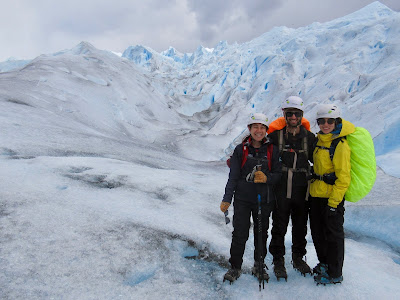
Lots of pictures of us on Perito Moreno- it was hard to resist all the photo opportunities.


You'll notice the ice looks "bluer" in this photo- Maya edited to "match her memory." 


The glacier naturally advances and recedes with the seasons, and occasionally butts up against a peninsula in front of it. This has two effects. First, the peninsula provides an incredible view out over the glacier. And second, the contact between the glacier and the land cuts the lake in two. On one side there is no drainage and the water level can vary by many meters. Eventually as the glacier recedes, water will burst explosively through and begin a long process of draining from one side to the other until the water levels equalize. Our next stop was a lookout on the point of the peninsula where there are a series of walking paths with different views of the glacier. Every so often, the glacier calved- the sound and the size of the splash helped but into perspective the enormity of the ice.

Walking on the glacier was a neat experience, but I think we all agreed that seeing the glacier from above is more impressive.  While walking on the glacier it's hard to truly sense how large and expansive it is since your view is blocked by the closest ice walls.

Another one of Maya's photos edited to "match her memory"


Matt (standing) and Maya (sitting)


Karen particularly liked the way this bright blue chunk of ice looked.  You can notice how much bluer it was by comparing it to the rest of the glacier in the photo above.
After our 10-hour tour, we had a couple hours of downtime at our hostel before catching a 3-hour bus ride to our next stop: Chalten.  The view from the bus was pretty neat- check out the shadow of the cloud below.  It looks like it's zooming by!


Penguins of Chiloe

This post is part of series all about Chiloe - Chile's second largest island! It's located in Chile's southern Lakes Region and known for seafood and a unique, spooky mythology.

Puñihuil Penguin Colony

Just an hour drive from Ancud, there are daily penguin tours... we had to check it out!  

Humbolt and Magellanic Penguins

We were instructed to drive along the beach to get to the launch point for the tour.  Little did we know the penguins were within a 5-minute boat ride on the 4 islands in sight!  On all other penguin tours we've done, we've had to ride out at least 15 minutes off the coast. 

To get to the 40-person tour boat, we boarded rolling platforms and allowed the tour staff (suited up with long rubber boots) to push us out into the water for dry access to the boat.


It was fun to watch the penguins awkwardly wobble from the upper level of the islands (where they nest) down to the water (where they fish).


Why is Karen making that face!?
A note for future penguin-seekers: Some of the best food we ate on Chiloe was right here! We got a milcao and a seafood empanada from a small stand on the beach that were very delicious.

Sunday, January 5, 2020

Muelles of Chiloe

This post is part of series all about Chiloe - Chile's second largest island! It's located in Chile's southern Lakes Region and known for seafood and a unique, spooky mythology.


Muelle de las Almas


In 2005, Chilean artist Marcelo Andrés Orellana Rivera created an installation on Chiloe's west coast called the "Dock of Souls." According to local indigenous myths, the souls of the dead are carried to the afterlife on a ghost ship. The Dock of Souls is situated on the site where souls board the ship. A sign at the site explained that, prior to the 1960 earthquake, caves in the cliff face caused sea foam to spew up into the air, at times forming a ship-like shape. We cannot confirm or deny, since the earthquake destroyed those caves. To reach the Dock of Souls from Castro, we first drove across the width of the island, then along the coast on a narrow dirt road. We parked up in the hills, set back a few kilometers from the coast, and went the rest of the way on foot- the hike takes about an hour each way and winds through serene rolling hills filled with grazing sheep.


The Dock itself is just a wooden pier that slopes upwards. The hill drops away below it, making it appear to lead out into the sky, or towards the horizon. A small line of people waited to walk out on it and take a picture. We overheard someone say that during the height of tourist season (January) the line can wrap all the way back up the hill- at least 100 people! Luckily for us the line was only 10 people and nobody was in a rush.


Kayla enjoys a solo moment on the Muelle de Las Almas

Muelle de la Luz


Note that this Muelle spirals under itself!

The same Chilean artist, apparently very pleased with his first Muelle, has also recently created a new one: The Dock of Light. This one is accessible by river boat from Chepu, and is also apparently much less well known. It is the same concept as the Dock of Souls, but has a more interesting spiral shape, and a more impressive view. While the Dock of Souls sits over a grassy hill, the Dock of Light hangs out over crashing waves and a thick growth of nalcas. We also had it almost entirely to ourselves.  Here are some scenes from the boat ride and short walk to the Muelle de la Luz.


If you squint to the right, you'll see a cow on shore :)

The beach was COVERED with delightfully smooth stones.


Nalcas- YUM!

Karen really liked the way the seaweed formed curly-q's in the ocean under the muelle.

From the Dock of Light we could see where a wide river crashed into the ocean, forming a kind of optical illusion where water seemed to flow in from both sides without flowing out (probably forming some kind of dangerous underwater rip current).


The river meets Ocean at this scenic junction.  However, the video doesn't capture it too well. 

Afterwards, we went farther upriver, where during the 1960 earthquake an entire forest sank 2 meters and was flooded. Dead treetops stick out all along the center of the river.


We rode past the Flooded Forest for a good 15 minutes upriver by boat. 

On a future trip, we'd consider kayaking through the smaller Flooded Forest channels.  Our guide commented that, despite kayaking's popularity in the area, it's not great because of all the sticks! Hehe

It's not a competition, but we liked Muelle de la Luz more, despite Muelle de las Almas' fame.

Cities (and Eats) of Chiloe

This post is part of series all about Chiloe - Chile's second largest island! It's located in Chile's southern Lakes Region and known for seafood and a unique, spooky mythology.


The view of Quinchao from Dalcahue


Overlooking the town of Achao

Ancud

Coming from Santiago, we flew into the local mainland hub (Puerto Montt) and drove from there, via ferry, to the northern tip of Chiloe. We spent our first night in Ancud, Chiloe's northernmost city. Ancud is a pretty small city, but we made the most of our time there by eating Chiloe's signature dish: curanto en hoyo. Curanto is a "soup" of shellfish, sausage, chicken, ham, milcao, and chapalele. Milcao is a doughy potato patty and chapalele is similar, but contains wheat flour. Curanto is traditionally prepared in a hole in the ground and cooked over hot stones, so there is no broth. Instead broth is served on the side to be drunk before, after, or during the meal. 


Our first Curanto in Chiloe!
We also took a chance on a night time mythology tour, thinking it would involve a walk around the city and some ghost stories. Instead, at 11PM we were picked up in a van and driven out of the city and into a native forest, where a local took us on a walk through the dark woods. The path was lined with statues of the island's mythical creatures: witches, invunches (deformed infants who guard the witches' cave), and voladoras (the witches' messengers, who vomit up their intestines to transform into birds at night). The path is also used during the day for a local flora and fauna tour, so when we stopped every 20 minutes or so we had to wait to see if our guide's flashlight would reveal a gruesome mythical monster, or a placard describing a native bird. At the end of the tour, we were invited inside for tea and homemade jam and a chat with our guide and the van driver.


A 2am snack in our tour guide's home

Castro

Castro is Chiloe's largest city and is very centrally located- ideal as a home base for exploring the island. It is known for palofitos- houses on stilts that raise them up above the water during high tide. Castro has a wider variety of restaurants than Ancud, including some upscale ones that cater to foreigners. At one, we enjoyed a cheesy king crab lasagna, and at another we ordered altogether too many mussels.


Kayla on her 4th!? ceviche of the trip


Dalcahue


The craft market originally lured us to Dalcahue, but the seafood kept us around for hours and even warranted a second visit!

Only a 20 minute drive from Castro, the small town of Dalcahue is a major hub where artisans and fisherman from the smaller islands of the Chiloe archipelago gather to buy and sell there wares. We enjoyed stopping here for the craft market, fresh cheese, and fresher seafood. 3000 pesos (~$4.50) bought as much sea urchin as we could eat. When asked where the urchin came from, the vendor pointed at the channel between Dalcahue and the nearest island and said "right over there." Divers harvested it that morning, and we watched her open it. Inside the sea urchins was a shock: tiny parasitic crabs, called Pancora, living within the urchins. The vendor explained that these are snack to be enjoyed in moderation, as they are high in iodine. You also aren't supposed to rinse them off before consuming, as this "washes away" some of the flavor!?  We all tried one- you press them to the roof of your mouth to suck out the briny juice, and then spit out the husk. Our verdict: pretty good, for a once in a while snack.
Fresh oysters- the plate for $5,000 CLP or $7USD


Karen accidentally ordered Kayla a "poto" (butt) of urchin instead of a "pote" (container).  The vendor didn't even blink twice :0
We held off on raw piure this trip.


Pancora, Pancora, Pancora


Following Matt's lead

Steamed Picorocos, or barnacles, have a crab-like meatiness.  Full disclosure- this picture is from a restaurant at the Mercado Central in Santiago, but it slides in nicely with the seafood images here.  

After exploring Dalcahue, we drove onto yet another ferry to take us to the neighboring island of Quinchao.  3 days into Chiloe and we've ridden boats everyday!  


In Quinchao, we drove to the oldest church in Chiloe.  Chiloe is known for its old wooden churches and boasts 30+... some tourists come here to conquer the "Ruta de Las Iglesias" and visit them all.  It's a funny contrast with all the talk of witchcraft and mythology on the island.  Seems like you had to pick a camp and stick to it back in the day.  If we were different people, this blog might be entirely dedicated to the churches of Chiloe.  We refrained to two over our 5-day stay.


The woodworking techniques present in these churches originate from boat-building.

The Andes dotting the horizon were a fun twist on the island scenery.

Kayla pleased to take a driving break in the passenger seat.