Wednesday, June 26, 2019

A Blast to the Past

Karen and the VOZ Family
In undergrad, Karen interned with an ethical fashion company called VOZ.  Recently, we spent a weekend reconnecting with the VOZ weavers in and around Labranza, Chile.  This was particularly fun for Matt, who has been hearing about Labranza and VOZ for over 6 years now.   Here's a quick blurb about VOZ:

"VOZ is a B Corporation certified ethical fashion company whose mission is to protect the livelihoods, well-being, and cultural values of rural indigenous women globally. We pay living wages for every textile and sewn garment, and use sustainable fibers and processes.  VOZ was founded in 2012 by Jasmine Etoile Aarons, and today provides over 100 jobs throughout our supply chain."

Check out their website here and please do buy something if you feel so inclined!


Casa Voz
The surrounding neighborhood.


We had the luxury of staying in the VOZ headquarters which doubles as a gorgeous home.  Since it's Winter, temperatures easily drop down to 2C (35F).  The primary method for heating homes is a central wood fire.  We were lucky enough to be greeted by a healthy, warm fire upon arrival when a weaver met us.  However, alone the next morning, we were not so lucky.  After about half an hour, we hadn't had any luck getting it started.  Karen was particularly embarrassed since she regularly made the fires during her internship.  Eventually, we gave up and had a bona-fide Chilean come over and show us the ropes.  Here are some of the pointers we needed:


Starting a successful fire, whew!
1) The hearth was full of ashes.  We were advised to remove most of the ashes since they can absorb oxygen and make it hard to start a fire.

2) We were using napkins as our initial kindling.  Rookie mistake!  Apparently they're notoriously poor for starting fires.  It's much better to opt for denser cardboard, and don't be stingy.

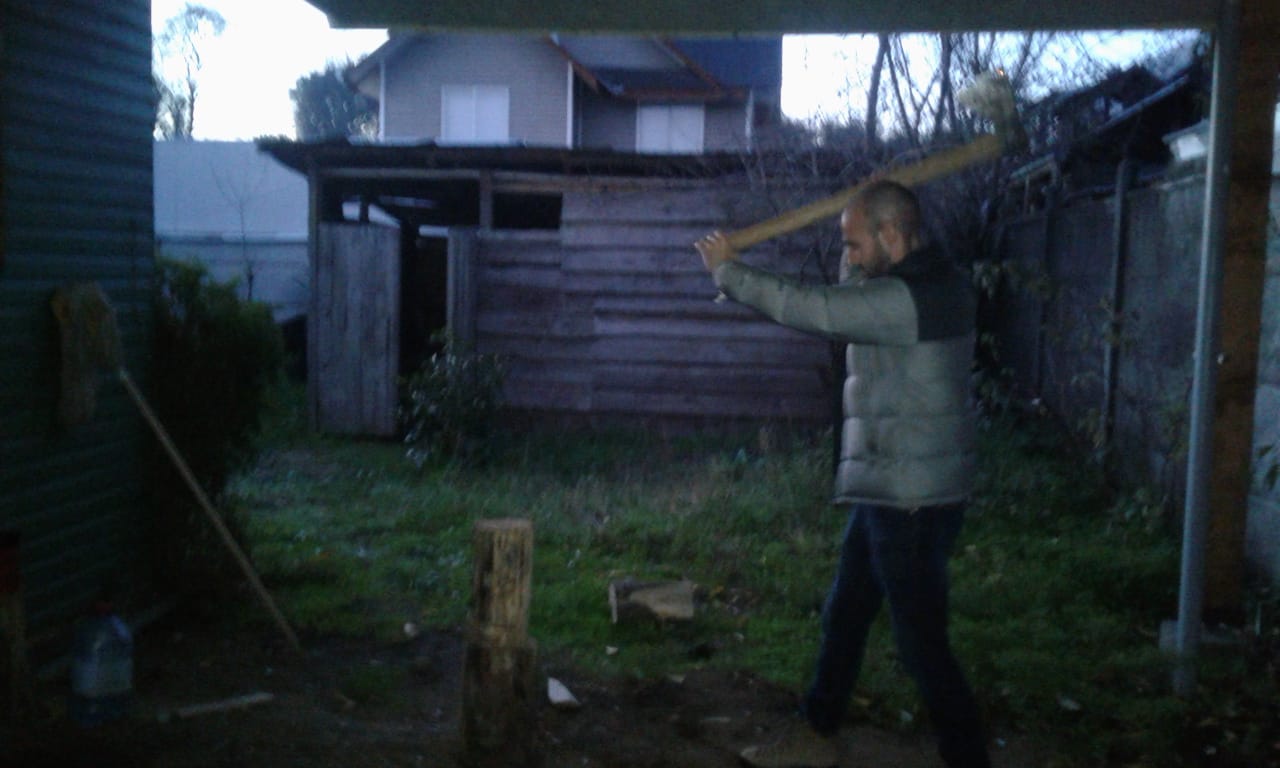
3) We were missing small pieces of wood... where to get them?  The shed in the backyard was equipped with an axe and full-round logs.  Time to get chopping!


Matt chopping wood by day...
... and night!

This was one of Matt's first logs... his aim got a LOT better as the weekend continued.

After morning #1, we were self-sufficient fire makers.


Enjoying the warm house with some cold beers.
One perk of staying in the VOZ house is that weavers regularly stop by to drop off their textiles for orders.  So, there was a consistent flow of people coming to and from the house.  We also got to head out to the farmlands and visit a couple weavers on their farms.  To read more about weaving and farm life, check out this blog post.  

Winter in Labranza is notoriously rainy, but we lucked out with 5 days of consecutive sun!  (It rained for several days before and after our trip.)

Waiting to be picked up by the VOZ truck for an excursion into the farmlands.


While exploring the farms, the weavers pointed out different plants that are used as natural wool dyes.  Here are a few.


Maquí leaves and branches dye green.

The chrysanthemum flower dyes grey.

The Pica Pica flower dyes yellow.

Bárba de hualle moss dyes orange, like the root pictured.
"Bárba de Hualle" translates to beard of the Hualle tree... now it's Beard of Matt too!

In addition to the VOZ family, we also caught up with Karen's friends and neighbors from 2011.

When we visited the family that lives across the street from the VOZ house, we were invited inside for tea and desserts and spent at least 3 hours talking, catching up, and jokingly calling Karen "la señora" because she's married.

Eating an average-sized plate of "Chorrillana", or loaded french fries.

Enjoying a local cider at Los Tonelos.

Karen found a few unexpected updates in Labranza.  When we first got off the bus she was disoriented because many of the small dirt roads have been replaced with wide, paved roads, complete with stoplights.  In addition, the main downtown strip now sports a Mall, a second large supermarket, and take-out sushi!  Last but not least, the "Kareen Manukian" Mega Plastic chain has made also it's way into town.  


We'll leave you with this sign we saw by the side of the road in Nueva Imperial, a town adjacent to Labranza.


Wednesday, June 12, 2019

Pomaire


Last weekend, we went on a day trip to Pomaire with Karen's Chilean friend from 2011.  Located about an hour's drive southwest from Santiago, Pomaire is traditionally famous for its pottery.  Other than food and craftwork along a main downtown street, there's not much else to do so some other friends were surprised we happily filled a full day wandering around!  At one point, we tried to get to a pretty lookout point on top of a hill outside the city, but there was no real path.

Restaurants and homes throughout Chile tout Pomaire's wares.  It's usually unglazed, which leaves me to wonder how sanitary it is.  A friend of our who takes pottery classes back home told us that un-glazed pottery has lots of pores for bacteria and germs to hang out in.  Nobody in Chile seems too worried.  Our friend ordered coffee in a clay mug- after finishing the beverage we inspected the cup to confirm that it is in-fact stained with coffee from past pours.  Oh well.


Pomaire is also known for its pig imagery- there is an old story about a three-legged pig that was born here. At first people thought it was bad luck and wanted to kill it, but they let it live and the owners had good luck! So now the town is filled with clay pigs. Strangely though, we didn't see a single actual pig.

Fun fact, if you "google" the city Pomaire this photo appears first.  Only our most fervent fans will recognize this as Karen's very own photo from her 2011 blog post.  It's subsequently been uploaded to several tourism websites. Karen second-guessed whether or not it was actually her photo after seeing this, but then she found the original on her laptop!


Karen's now-famous photo of Pomaire from 2011
We were googling Pomaire to figure out transportation when Karen stumbled across the photo!  It was a funny experience to be trying to research something on the internet only to find information that you posted a few years back.  Originally, we had considered renting a car for the outing, but it turns out automatic transmission car rentals cost double that of manual ($30 vs $60 USD/day) since almost nobody in Chile drives automatic.  So, instead we took a bus from Santiago's main terminal, which turned out to work perfectly well.  It took quite a bit of internet research to locate the bus, so for those who are interested you can take Ruta Bus 78 to Melipilla which leaves every 10-20 minutes. Get off a little early at a stop along the highway, and walk around 15 minutes to reach Pomaire.

We quickly caught on to the fact that Pomaire is also pushing a new agenda to stay "relevant"- anything and everything here can now be found in a ridiculously large format.  


In the photo above, the 3 of us split a famous 1 kg Empanada (we had ours cut into there pieces, but see this image below for an uncut one).  These 1kg empanadas are advertised at every restaurant along the main strip.  I'm not sure why, but the waitress at our restaurant made sure to explain that their empanada was only 900 grams.  Does it actually weight 1kg but they say 900 grams to be safe?  Did the chef decide that the extra 100 grams would destroy the pastry's structural integrity?  We'll never know...  What we do know for sure, is this was one of the tastier empanadas we've had.  We were all struck by that fact that it wasn't *too* salty.  Kudos to Restaurante San Antonio for holding back the salt- this is the first time I've bought an empanada in Chile and didn't find it at least a little too salty for my liking.

1 kilogram Empanadas
Next up- a giant clay pig!  This novelty combines both of Pomaire's draws.  You have to pay 500 pesos (appox 80 cents) and walk 1/2 kilometer out of downtown to see this pig.  Matt was gung-ho about it so we came along.  It's advertised as "the largest clay pig in the world" and was featured on TV.  What left us a bit confused is it didn't quite sound like clay when we tapped it.  I have a feeling it's made out of a plastic or plaster mold and covered with a top layer of clay.


Giant parking!? 


Saturday, June 8, 2019

Cajón del Maipo


 We were itching to get out of Santiago's concrete jungle, so we decided to visit Cajón del Maipo for the day. Cajón del Maipo is a small town smushed right up against the Andes, and is a jumping-off point for all kinds of mountainous destinations and activities. We had an opportunity to go with a group a month ago, but we've been waiting for snow so that the Andes will look their best. Now that winter is here, there's nothing holding us back.

 While researching different ways to arrive, we found a company that does very affordable bus tours from Santiago. After checking the reviews, we signed up.

 The small van was filled almost entirely with Brazilian tourists. Unfortunately, since there was one other American, and the only Chilean present spoke perfect English, the tour guide spoke English and Portuguese the entire time. But it was still fun listening to his Portuguese- maybe it's because he spoke with a Chilean accent, but we could understand almost every word he said!
The view from Cajon del Maipo's main plaza
  Our first stop was a small shop were we got coffee and 2 very tasty freshly-made empanadas, one with a "pino" meat/onion filling and another with cheese and shrimp. The owner of a nearby store wandered over and tried to tempt us with a bunch of strange words. We were excited to learn new Chilean vocab, but it turned out she was just saying "gloves" and "hats" in Portuguese because she assumed we were Brazilian- a reasonable assumption given the make up of our tour group.

 The second stop was a "train". It's the last remnant- or maybe a reconstruction- of the train line that used to run through all the towns in the area, bringing goods from Santiago out to the wilderness. The project to restore this train line is appropriately called "Project Phoenix", and this was by far the stop our guide was the most excited about, and proud of. The only Spanish we got to hear was our guide talking to the driver, gushing about the train stop and criticizing other tour companies (including one that does a tour of Santiago's malls and shopping centers, for people who want to shop all day!).

The train station- about 500 feet of track run to a fence and back. 
 After the train, our van began winding its way farther into the mountains. We stopped in an area with bathrooms and had a view of a far-off glacier. We also spotted our first condor. In a way, condors are just big vultures. But when you see them soaring over the Andes, they somehow manage to seem pretty majestic.


Our rest stop
The glacier we could see from our rest stop- thanks to the incredible zoom on Karen's camera
Finally we made it to the Main Attraction: Embalse el Yeso, a picturesque water reservoir high in the mountains. Unfortunately, we were given an absurdly (and unnecessarily) short amount of time to explore. The path curved around a mountain and we weren't able to make it around the corner to see anything other than the "standard" view (pictured here). After the Embalse, we all stood around eating cheese and wine, which was nice, but we would've preferred more time to look around. According to one person, the trail eventually goes all the way through to Argentina.

The "standard" view


 The last stop listed on our itinerary was a chocolate shop. Matt fell asleep on the way back, eager to wake up for chocolate- but we skipped it completely! We asked the guide what happened and he said we didn't have enough time. So we skipped the chocolate and didn't even get more time at the Embalse? Overall, the tour was a good way to get an idea of what is in and around Cajon del Maipo, and to give us a better idea of what getting there entails, since no public transport is available for this route. And it was fun. But we definitely plan on going back on our own schedule and car.


Friday, June 7, 2019

La Chascona

Photo from Google - You are not allowed to take photos in La Chascona
 The famous Chilean poet Pablo Neruda had three houses in his native country- in Valparaiso, Santiago, and Isla Negra. Dedicated readers will recall that we visited his home in Valparaiso (named La Sebastiana) soon after arriving in Chile. Recently, we visited his home in Santiago, which he named "La Chascona," a Quechua word meaning "wild-haired woman".

Photo from Google
 Both houses are strange, whimsical constructions that reflect Neruda's eclectic tastes and quirky tendencies. La Chascona is built to make you feel like you are inside of a boat, with small doors, low ceilings, and long passageway-shaped rooms. In this regard, it is successful. Neruda apparently insisted on rotating the entire design 180 degrees so it would have a view of the Andes. In this regard, it is less successful, since nowadays the Andes are barely visible through the smog 90% of the time.

Photo from Google
 La Chascona is named in honor of Matilde Urrutia, his final wife. In fact, he built it specifically for her to live in while their relationship was still in the "clandestine affair" stage. Like the "view" of the Andes, this is another fact that dates the house, since nowadays we can't think of anything that would draw MORE attention to an affair than constructing a house for someone. The tour in La Sebastiana did not go into much detail about Neruda's love life, but in La Chascona it's hard to avoid, because the entire house was built for his mistress whom he later married. Yet the tour kind of tiptoed around the topic, describing the various women in Neruda's life in pretty much the same terms as the countries he visited: "After that he visited France. In this time, he met Lucy and married her. After 5 years serving as ambassador to France, he moved to Mexico and reconnected with Matilde, who he married. He spent the rest of his life in Chile, married to Matilde."

Photo from Google
 The tour also focused on Matilde in unexpected ways. We had the opportunity to peer into her bathroom, where we were informed that EVEN when she was sick, she NEVER stopped looking after her appearance.

Photo from Google - a long, narrow hallway meant to evoke the feeling of being on a ship. Not pictured: salt and pepper shakers labeled "marijuana" and "morphine"
Photo from Google